Get the latest Iranian garlic bulk pricing CIF Astrakhan. Learn how Russian wholesalers secure premium garlic with reliable logistics from Happy King.
Table of Contents:
For industrial food processors, garlic distributors, and high-volume wholesalers across the Eurasian Economic Union (EAEU) and the Russian Federation, sourcing high-quality agricultural commodities requires a deep understanding of agricultural science, international trade compliance, and cold chain logistics. Among global garlic producers, Iran stands out as an elite cultivation origin, offering crops characterized by exceptionally high dry-matter content, rich essential oil concentrations, and intense pungency. Securing a reliable pipeline of Iranian garlic bulk shipments is a highly effective strategy for procurement teams looking to optimize both their product quality and supply chain resilience.
This technical whitepaper provides a comprehensive, operational framework for sourcing, evaluating, and importing Iranian garlic bulk, with a specific focus on CIF Astrakhan maritime logistics, phytosanitary compliance under Rosselkhoznadzor regulations, and advanced quality assurance protocols. As a leading agricultural trade partner, Happy King (Aghigh Tejarat Golshan) presents this guide to assist procurement officers in making data-driven sourcing decisions.
The unique geographic and climatic profile of Iran—ranging from the high-altitude, arid plains of Hamadan to the fertile, subtropical coastal zones of Gilan and Mazandaran—produces garlic (Allium sativum) with physical and chemical profiles that outperform varieties from other global origins.
From a technical perspective, the primary indicator of garlic quality is its concentration of organosulfur compounds, specifically alliin and its enzymatically converted active form, allicin. Allicin is responsible for the characteristic pungent aroma, sharp flavor profile, and natural antimicrobial properties of the bulb. High-altitude farming regions in Iran, where crops experience significant diurnal temperature variations and mineral-rich soils, yield garlic with an allicin concentration often exceeding 4.5 to 5.2 mg/g of fresh weight. This is substantially higher than the global baseline average of 3.0 to 3.8 mg/g.
Furthermore, Iranian garlic bulk crops exhibit a remarkably high dry matter content, typically ranging between 38% and 42%. A high dry matter percentage is critical for several commercial reasons:
Importing agricultural goods into the EAEU, and specifically through the port of Astrakhan into the Russian Federation, requires strict adherence to phytosanitary regulations. The Russian Federal Service for Veterinary and Phytosanitary Supervision (Rosselkhoznadzor) enforces strict Maximum Residue Limits (MRLs) for pesticides and heavy metals, as well as zero-tolerance policies for quarantine pests. To ensure a seamless import process, it is vital to source your product from an experienced supplier who understands these stringent requirements.
When importing Iranian garlic bulk, the consignment must be accompanied by an official Phytosanitary Certificate issued by the Plant Protection Organization (PPO) of Iran. This documentation must explicitly state that the shipment is free from critical quarantine pathogens and pests, including:
At Happy King (Aghigh Tejarat Golshan), every batch of export-grade garlic undergoes comprehensive pre-shipment laboratory analysis. We utilize gas chromatography-mass spectrometry (GC-MS) and liquid chromatography-tandem mass spectrometry (LC-MS/MS) to verify that all pesticide residues are well within EAEU limits. This rigorous compliance focus is consistent with our broader export initiatives, such as our compliance frameworks as a Premium Iranian Bell Pepper Exporter, where we maintain strict adhere to EAEU sanitary-epidemiological requirements.
Source premium wholesale Iranian garlic in bulk with guaranteed export quality and reliable CIF shipping to Astrakhan and global markets.
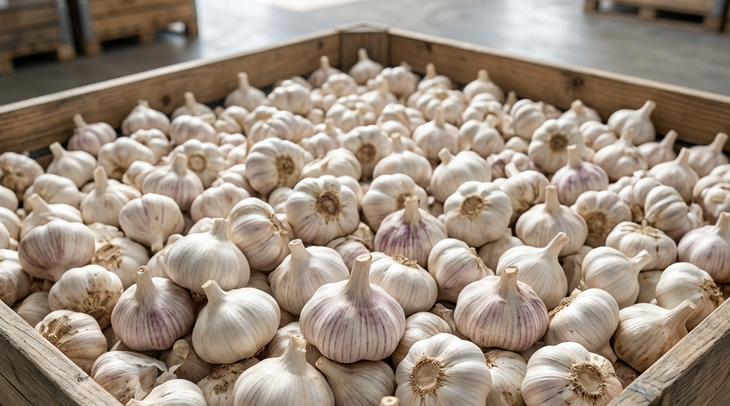
To establish clear specifications during the Request for Quotation (RFQ) stage, buyers must understand the standardized grading metrics applied to export-ready garlic. The physical calibration of garlic is determined by measuring the maximum equatorial diameter of the bulb.
| Caliber Grade | Equatorial Diameter (mm) | Average Bulb Mass (g) | Clerical Configuration (Cloves per Bulb) | Primary Commercial Applications |
|---|---|---|---|---|
| Super Extra (Jumbo) | 60mm + | 85 – 110g | 8 – 12 (Large, uniform) | High-end retail, fresh produce markets, premium packaging |
| Extra | 55 – 60mm | 65 – 85g | 10 – 14 | Standard retail chains, wholesale distribution |
| First Class (Standard) | 50 – 55mm | 50 – 65g | 12 – 16 | Industrial processing, peeling facilities, food service |
| Processing Grade | 40 – 50mm | 35 – 50g | Variable | Dehydration, garlic powder, oil extraction, pickling |
In addition to sizing, the visual and structural attributes of the garlic are classified into distinct quality tiers. Premium grade Iranian garlic bulk demands that bulbs are:
The journey from field to final container is critical in preserving the quality of Iranian garlic bulk. Raw garlic harvested from fields in Hamadan or Gilan contains high levels of field heat, moisture, and soil contaminants. Without proper post-harvest handling, packing garlic directly into refrigerated containers leads to immediate condensation, mold proliferation, and high spoilage rates.
At Happy King (Aghigh Tejarat Golshan), we manage a highly sophisticated, multi-stage post-harvest processing line designed specifically to protect the quality of agricultural exports. This level of quality management mirrors the systems that explain Why Iranian Apples Are Popular across demanding international markets—namely, absolute consistency, modern cold preservation, and advanced sorting technology.
Upon arrival at our sorting facility, the garlic is placed in specialized curing chambers. Large-volume industrial fans circulate temperature-controlled dry air (25°C to 30°C) with a relative humidity below 60% through the bulbs for 72 to 96 hours. This process cures the outer skins into a papery, protective shell, seals the neck of the bulb against fungal entry, and reduces the moisture content of the outer layers to safe levels.
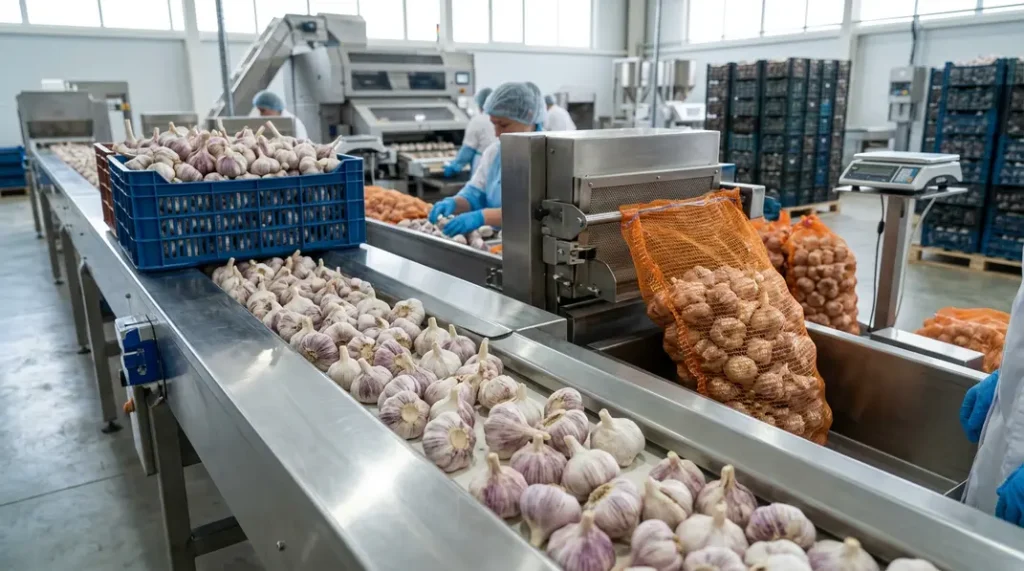
Once cured, the garlic is transferred to our state-of-the-art sorting line. Manual sorting is prone to human error, which is why we integrate high-speed optoelectronic and AI-driven sorting systems. These machines utilize advanced multispectral imaging cameras to scan each bulb in real time, evaluating parameters such as:
This automated quality control ensures that every ton of Iranian garlic bulk shipped under the Happy King brand meets strict international wholesale standards.
Suggested Reading:
Packaging selection directly impacts both ventilation during maritime transit and physical protection against compression damage. For B2B importers ordering Iranian garlic bulk, we offer several packaging options tailored to specific storage and retail needs.
| Packaging Type | Net Weight per Unit | Material Specifications | Pallet Loading Configuration | Primary Benefit |
|---|---|---|---|---|
| Monoblock Plastic Crates | 8.0 kg / 10.0 kg | High-Density Polyethylene (HDPE), food-grade, fully ventilated | 104 crates per pallet (approx. 1,040 kg net) | Maximum air circulation, zero compression damage, reusable |
| Laminated Cardboard Cartons | 10.0 kg | Double-wall corrugated board with external moisture-resistant lamination | 80 cartons per pallet (approx. 800 kg net) | Excellent branding surface, ideal for direct-to-retail supply chains |
| Leno Mesh Bags | 5.0 kg / 10.0 kg / 20.0 kg | High-strength polypropylene mesh with integrated drawstring | Loose-loaded or stacked on pallets with protective outer stretch-wrap | Most cost-effective option, excellent ventilation for rapid turnover |
For shipments traveling to Northern ports, particularly on the Caspian route, palletization is highly recommended. Pallets are constructed using ISPM-15 heat-treated wooden structures (800x1200mm Euro-pallets or 1000x1200mm Industrial pallets). Securing crates or cartons to pallets with corner protectors and ventilated stretch wrap ensures load stability during sea voyages, preventing cargo shifting and physical damage.
Shipping Iranian garlic bulk to Astrakhan requires a carefully managed maritime supply chain across the Caspian Sea. As a strategically vital inland sea trade corridor, the route from northern Iranian ports—primarily Bandar Anzali, Caspian Port, and Amirabad—to the Port of Astrakhan (including Olya Port) provides direct access to the heart of the Russian and broader EAEU market.
Because garlic is a living agricultural product, maintaining precise environmental controls during shipping is essential to prevent degradation. We manage this risk through a strict refrigerated container protocol.
The maritime transit time from Bandar Anzali to Astrakhan typically ranges from 4 to 7 days, depending on sea state, weather conditions, and seasonal congestion at the Volga-Don Canal entrance. By maintaining an unbroken cold chain from our cold storage facilities in Iran to the customs terminals in Astrakhan, Happy King guarantees that our Iranian garlic bulk arrives in optimal condition.
Navigating international B2B agricultural trade requires clear financial agreements and robust customs compliance protocols. Happy King operates with transparency, compliance, and risk mitigation at every step of the process.
Due to seasonal crop variations, fluctuations in fuel costs, maritime freight rates, and international exchange rates, fixed-price lists are often impractical for large-volume transactions. We utilize a dynamic RFQ (Request for Quotation) model to provide our clients with accurate, up-to-the-minute pricing.
To secure the best CIF Astrakhan / Nhava Sheva / Moscow price per ton, request a live quote from our trade desk.
We offer flexible payment terms designed to support secure B2B partnerships. Standard transactions are typically structured around:
Astrakhan serves as a primary customs gateway into the Russian Federation. To facilitate rapid customs clearance and avoid costly demurrage fees, Happy King provides a comprehensive, error-free documentation package. This package is meticulously prepared to align with EAEU customs regulations and includes:
Sourcing agricultural products at scale requires more than simply finding a supplier; it requires partnering with an experienced exporter who can guarantee quality, manage complex logistics, and navigate strict international regulations. For volume importers looking to secure premium Iranian garlic bulk, Happy King (Aghigh Tejarat Golshan) delivers an unmatched combination of agricultural expertise, advanced post-harvest processing, and reliable Caspian Sea shipping solutions.
By choosing Happy King as your preferred supplier, you gain access to:
Whether you are supplying major retail chains in Moscow, distributing to wholesale markets across the CIS region, or sourcing raw materials for industrial food processing, our team is equipped to meet your volume and quality requirements. Let us help you streamline your supply chain and secure your next shipment of premium garlic.
To discuss your seasonal volume requirements, review custom packaging specifications, and receive a competitive CIF Astrakhan / Nhava Sheva / Moscow price per ton, contact the Happy King trade desk today to request a live quote.
Our Minimum Order Quantity (MOQ) is one full container load (FCL), which is approximately 20 to 22 metric tons loaded inside a 40-foot high-cube reefer container. We primarily supply under CIF (Cost, Insurance, and Freight) terms to key regional hubs including the Port of Astrakhan, Olya Port, Moscow, and Nhava Sheva, handling all maritime transport, export declarations, and freight insurance.
We implement a strict refrigerated logistics protocol. During maritime transport across the Caspian Sea, our reefer containers are set to a continuous temperature of -1.5°C to -2.5°C, with relative humidity maintained strictly between 65% and 70%. Fresh air ventilation is set to 15–25 cbm/h to remove metabolic CO2 and ethylene. Combined with our advanced 72-to-96-hour forced-air pre-curing process, this completely suspends the bulb’s biological clock and prevents sprouting or mold growth.
To ensure rapid customs clearance at Astrakhan and other EAEU entry points, Happy King provides a comprehensive, compliant documentation package. This includes an official Phytosanitary Certificate from the Iranian Plant Protection Organization certifying freedom from critical pests like Ditylenchus dipsaci, a Certificate of Origin (Form A/EAEU-Iran PTA), a commercial invoice with correct HS codes, an international Bill of Lading, and the EAC Declaration of Conformity proving compliance with TR CU 021/2011 and TR CU 022/2011.
We process our garlic using advanced optoelectronic and AI-driven sorting lines. High-speed multispectral cameras scan every bulb to ensure precise physical calibration (Jumbo 60mm+, Extra 55-60mm, Standard 50-55mm, and Processing 40-50mm). Simultaneously, near-infrared (NIR) sensors analyze the internal density of the bulbs, allowing us to detect and automatically discard garlic with internal rot, hollow centers, or early sprouting that is invisible to the human eye.
We offer three standardized B2B packaging options optimized for cold-chain ventilation: 1) High-Density Polyethylene (HDPE) Monoblock Plastic Crates (8.0 kg / 10.0 kg) which offer zero compression damage; 2) Double-wall Laminated Cardboard Cartons (10.0 kg) featuring moisture-resistant lamination for direct retail distribution; and 3) High-strength polypropylene Leno Mesh Bags (5.0 kg to 20.0 kg) for maximum air circulation and cost efficiency. All packaging can be fully palletized on ISPM-15 heat-treated Euro-pallets.
Market dynamics and vessel space to Astrakhan fill up quickly. Contact our export desk now to request a custom proforma invoice (RFQ), verify strict customs and phytosanitary compliance, or review complete technical specifications for our premium Iranian garlic.