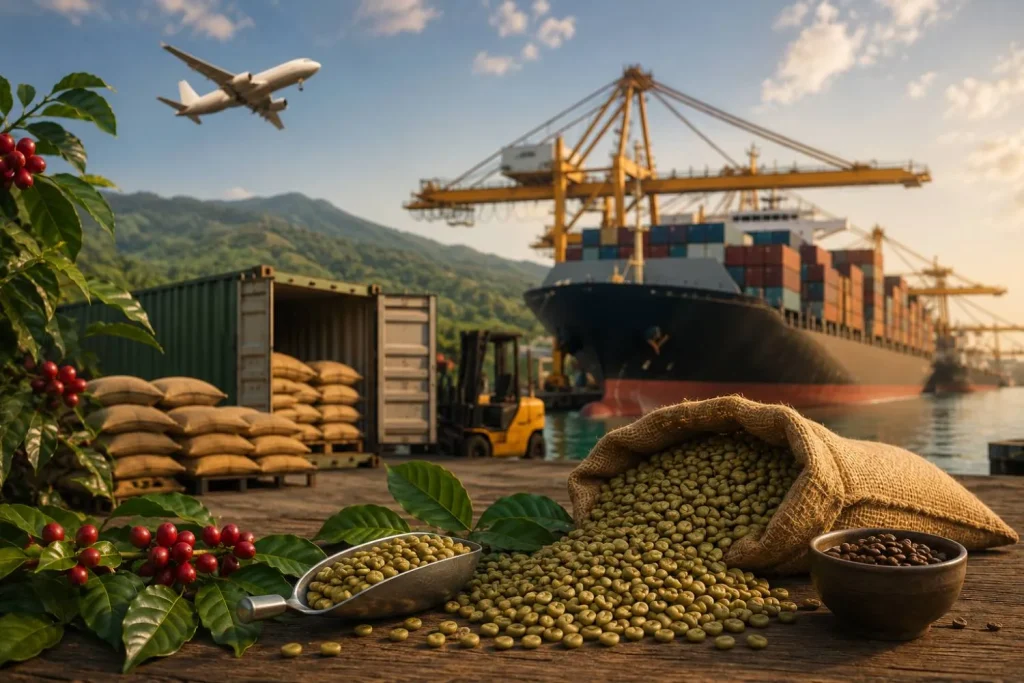

Understand the total green coffee costs. Our B2B guide breaks down freight, tariffs, and other hidden fees for importers and roasters to optimize their sourcing.
For coffee importers and roasters, understanding the true **green coffee costs** is the cornerstone of a profitable and sustainable business. The price you see on an offer sheet is merely the beginning of a complex financial journey from a remote farm to your warehouse. A superficial grasp of these costs can lead to eroded margins, unexpected expenses, and supply chain disruptions. A deep, strategic understanding, however, empowers you to make smarter purchasing decisions, optimize logistics, and build a resilient brand.
This comprehensive guide breaks down every component of **green coffee costs**. We will move beyond the basic Free On Board (FOB) price to reveal the full landed cost, providing the clarity needed to navigate the global coffee trade with confidence. As a leading international trading partner, we believe that transparency is not just good practice—it is the foundation of a successful partnership.
The journey of calculating your final **green coffee costs** begins at the origin, with the price paid to the farmer or cooperative. This initial price is influenced by a myriad of factors that directly impact the quality and character of the beans you ultimately receive.
The Farm Gate price is what a farmer or producer receives for their coffee cherries or parchment coffee. However, for most international buyers, the first significant pricing benchmark is the FOB (Free On Board) price.
The FOB price typically includes:
It’s crucial to understand that a low FOB price is not always a good deal. It can sometimes indicate lower quality beans, rushed processing, or an exporter cutting corners on crucial steps like sorting and quality control. The integrity of your export partner at this stage is paramount, as they are the stewards of your coffee’s quality before it even begins its international journey.
The way coffee is processed has a profound effect on its final flavor profile and, consequently, its price.
Understanding these methods helps you align your purchasing with your desired flavor profiles and budget.
The single largest driver of farm-level price is quality. Commodity-grade coffee is traded based on the C Market price, a global benchmark for standard-quality Arabica. Specialty coffee, on the other hand, is priced based on its cupping score (a standardized 100-point scale), unique flavor attributes, traceability, and story. A coffee scoring 88 points will command a significantly higher price than one scoring 83, as it represents a rarer and more exceptional sensory experience. Investing in higher-quality coffee means higher initial **green coffee costs**, but it translates into a superior final product that can command a premium from your customers.
Source high-quality green coffee beans directly. We are a trusted trading company for importers and roasters, offering a reliable supply chain for bulk Arabica and Robusta beans.
Once the coffee is processed, graded, and bagged, the next phase of costs involves getting it from the inland mill to the vessel at the port of origin. This is where the term FOB becomes reality, but the efficiency of this stage can heavily influence your overall financial outcome.
The FOB price bundles many of these services, but a weak link in this chain can cause costly delays. An experienced trading partner manages:
These logistical steps are critical components of the initial **green coffee costs** and should be managed by a partner with a proven track record of reliability.
With the coffee loaded at the origin port, the next significant expense is the international journey to your country. These costs are volatile and require expert management to control.
Ocean freight is a major variable in your landed **green coffee costs**. Prices fluctuate based on global demand, fuel prices, port congestion, and carrier availability.
Marine insurance is a non-negotiable expense. It protects your investment against loss or damage during transit. The cost is typically a small percentage of the coffee’s total value (CIF value – Cost, Insurance, and Freight), but failing to secure adequate coverage is a risk no professional importer should take. Your trading partner should be able to facilitate comprehensive insurance as part of their service.
Your coffee has arrived, but it’s not in your warehouse yet. The final leg of the journey involves clearing customs and paying local duties and fees. These can be a significant and often underestimated part of the total **green coffee costs**.
While many countries, including the United States, have historically had zero tariffs on unroasted green coffee, the global trade landscape is dynamic. It is essential to verify the current tariff schedule for your specific country. Any applicable tariffs are usually calculated as a percentage of the coffee’s declared value. For U.S. importers, it’s wise to consult the Harmonized Tariff Schedule and stay informed. Authoritative resources like the U.S. Food & Drug Administration (FDA) provide critical information on import requirements for food products like coffee.
Beyond tariffs, importers face several mandatory fees:

To illustrate how these costs accumulate, let’s analyze a hypothetical shipment of one 20-foot container (19,200 kg) of specialty grade Arabica coffee from a South American origin to a U.S. port.
Note: These figures are illustrative estimates and can vary significantly based on origin, quality, freight market, and other factors.
| Cost Component | Estimated Cost per KG (USD) | Description |
|---|---|---|
| FOB Price (Specialty Grade) | $6.50 | Includes the coffee itself, processing, milling, bagging, and transport to the origin port. This is the base of your **green coffee costs**. |
| Ocean Freight & Insurance | $0.25 | Highly variable cost for shipping one FCL container, including marine insurance. |
| CIF Price (Cost, Insurance, Freight) | $6.75 | Your coffee’s value upon arrival at the destination port, before customs clearance. |
| Customs Clearance & Fees | $0.10 | Includes Customs Broker fees, MPF, HMF, and other documentation fees. |
| Local Port Charges & Inland Trucking | $0.15 | Cost to get the container from the ship, through the port, and trucked to your final warehouse. |
| Total Landed Cost per KG | $7.00 | The true, final cost of the green coffee delivered to your door. This is nearly an 8% increase from the initial FOB price. |
This breakdown clearly shows that the final landed cost can be 5-15% higher than the FOB price, depending on freight and other variables. Factoring this into your financial planning is essential for maintaining healthy margins.
A partnership with Happy King (Aghigh Tejarat Golshan) is an investment in cost control, quality assurance, and supply chain stability. We don’t just sell coffee; we provide a comprehensive service designed to mitigate risks and optimize value for our B2B partners.
Our commitment to quality begins with technology. We utilize state-of-the-art AI-powered sorting machines that analyze each bean for size, color, and density. This process removes defects, foreign matter, and under-ripe beans with a precision that is impossible to achieve with manual sorting alone. For our partners, this means a higher yield in the roaster, less waste, and a more consistent product, directly improving the return on your **green coffee costs**.
Every batch of coffee we source is subject to rigorous quality control protocols that meet international food safety standards. We provide complete traceability back to the farm or cooperative level. This transparency isn’t just about storytelling; it’s a guarantee of quality and ethical sourcing that protects your brand’s reputation and ensures you are receiving exactly the quality you paid for.
Our experienced logistics team manages the entire supply chain, from the farm to your warehouse. We leverage our global network and shipping volume to secure competitive freight rates and ensure efficient transit. Our pricing is transparent, with a clear breakdown of costs so you can plan your finances with confidence. We handle the complexities of documentation and customs coordination, minimizing the risk of costly delays and allowing you to focus on what you do best: roasting exceptional coffee.
Ultimately, the true **green coffee costs** are not just a line item on an invoice; they are a strategic investment in the quality of your final product and the reputation of your brand. A cheap FOB price can be alluring, but it often leads to higher costs down the line through poor quality, logistical nightmares, and inconsistent supply.
By understanding every component of the landed cost—from the farm to your door—and partnering with a supplier committed to quality, transparency, and reliability, you can transform a complex expense into a powerful competitive advantage. At Happy King, our mission is to provide that partnership, ensuring that every dollar you invest in your **green coffee costs** delivers maximum value and exceptional quality.
The FOB (Free On Board) price is the initial cost of the green coffee, which includes the beans, processing, milling, and transport to the port of origin. However, your final landed cost is the true total cost to get the coffee to your warehouse. This includes the FOB price plus ocean freight, marine insurance, customs duties, port charges, broker fees, and inland trucking. As our example shows, the final landed cost can be 5-15% higher than the FOB price. We provide a transparent breakdown of all costs so you can plan your finances accurately.
Our state-of-the-art AI-powered sorting machines directly improve your profitability. By analyzing each bean for defects, size, and density with incredible precision, we remove imperfections and foreign matter that manual sorting misses. For you, this means a higher roasting yield (less waste), superior cup consistency, and the assurance that you are paying for only high-quality beans. This technology is a key part of how we protect your investment and ensure a premium final product.
We offer flexible shipping solutions to meet your needs. The most cost-effective method is a Full Container Load (FCL), which is typically a 20-foot container holding 18 to 19.2 metric tons of green coffee. Our typical MOQ is one FCL to ensure the best value for our partners. For smaller quantities, Less than Container Load (LCL) is an option, though the per-kilogram cost is higher. Our logistics team can advise on the most economical and secure shipping strategy for your volume.
We provide an end-to-end service that includes managing all logistical and administrative hurdles. Our experienced team handles the meticulous preparation of all required export and import documentation, including the Bill of Lading, Certificate of Origin, and phytosanitary certificates. We work with customs brokers to navigate tariffs, Merchandise Processing Fees (MPF), and Harbor Maintenance Fees (HMF), minimizing the risk of costly delays or compliance issues. This allows you to focus on your core business of roasting coffee, not on complex international paperwork.
Understanding the true cost is the first step. The next is partnering with a supplier who offers clarity, quality, and reliability. We provide a transparent supply chain for premium green coffee beans, helping you manage costs and secure consistent quality for your roastery. Contact our experts today for a custom quote on your bulk order.