

Source premium purple garlic wholesale with our complete B2B import guide. Learn how to secure high-quality bulk garlic shipments reliably.
Table of Contents:
In the global agricultural trade, securing a reliable, high-quality supply of premium fresh produce is a multi-faceted operational challenge. For agricultural buyers, food processors, and large-scale retailers, the sourcing of purple garlic wholesale requires a deep understanding of botanical specifications, phytosanitary compliance, cold chain logistics, and supply chain security. This technical whitepaper serves as an authoritative guide for international importers looking to navigate the complexities of bulk procurement, quality control, and international customs standards.
Purple garlic (Allium sativum var. ophioscorodon), particularly the hardneck varieties, is highly prized in international markets due to its robust flavor profile, elevated allicin concentration, and superior storage shelf-life compared to standard white garlic. However, executing a successful import program demands meticulous attention to post-harvest management, caliber consistency, and shipping configurations. This document outlines the industrial standards and commercial protocols necessary to optimize your import operations.
—Purple garlic is distinguished by its deep purple stripes or hues on the outer bulb wrappers. Unlike softneck white garlic, hardneck purple cultivars produce a woody central stalk (scape) and typically yield larger, more uniform cloves. This structural difference impacts both culinary application and processing efficiency.
Allicin (diallyl thiosulfinate) is the primary bioactive organosulfur compound responsible for the pungent aroma, sharp flavor, and antimicrobial properties of garlic. Laboratory assays demonstrate that premium purple garlic varieties exhibit significantly higher allicin concentrations than softneck white varieties. This high chemical potency makes purple garlic the preferred raw material for extraction facilities, pharmaceutical applications, and high-end culinary distribution.
From an industrial processing perspective, hardneck purple garlic offers a distinct structural advantage. The bulbs generally contain 8 to 12 large, easily separable cloves of uniform size arranged in a single layer around the central scape. This configuration minimizes waste during mechanical peeling processes, making it highly economical for industrial food manufacturers producing peeled cloves, garlic paste, or dehydrated garlic powder.
—Source premium wholesale garlic globally. Get direct B2B access to high-quality fresh garlic exports, reliable logistics, and competitive bulk pricing.
To ensure high market value and consumer satisfaction, international shipments must conform to precise physical and chemical metrics. When purchasing purple garlic wholesale, international buyers must establish rigorous Quality Assurance (QA) parameters with their suppliers.
Sizing is determined by measuring the maximum equatorial diameter of the bulb. Premium purple garlic is graded into specific calibers to meet retail and processing requirements. Bulbs must be free from external damage, mechanical bruising, and physiological defects such as sprouting or empty cloves.
| Grade Class | Bulb Diameter (mm) | Max Defect Tolerance (%) | Root/Stem Specification |
|---|---|---|---|
| Super Premium | 65mm + | < 1% | Roots cut to < 5mm; Stem cut to 10-15mm |
| Class I | 55mm – 64mm | < 3% | Roots cut to < 8mm; Stem cut to 15-20mm |
| Class II (Processing) | 45mm – 54mm | < 5% | Roots trimmed; Stem cut to < 25mm |
Compliance with Maximum Residue Limits (MRLs) and heavy metal tolerances is a non-negotiable legal requirement across major import jurisdictions, including the European Union, the Eurasian Economic Union (EAEU), and India. Importers must verify that their purple garlic wholesale partners utilize rigorous testing methodologies to guarantee chemical safety.
| Parameter | Maximum Limit / Requirement | Testing Standard / Protocol |
|---|---|---|
| Heavy Metals (Lead – Pb) | < 0.1 mg/kg | ICP-MS (Inductively Coupled Plasma Mass Spectrometry) |
| Heavy Metals (Cadmium – Cd) | < 0.05 mg/kg | ICP-MS Analysis |
| Pesticide Residues | Below EU/EAEU MRL limits | GC-MS/MS & LC-MS/MS Multi-Residue Screen |
| Fungal Pathogens (e.g., Fusarium) | 0% tolerance for active decay | Visual inspection & laboratory culture verification |
| Sprouting Index | < 1.5% of consignment by weight | Physical internal inspection of sample batches |
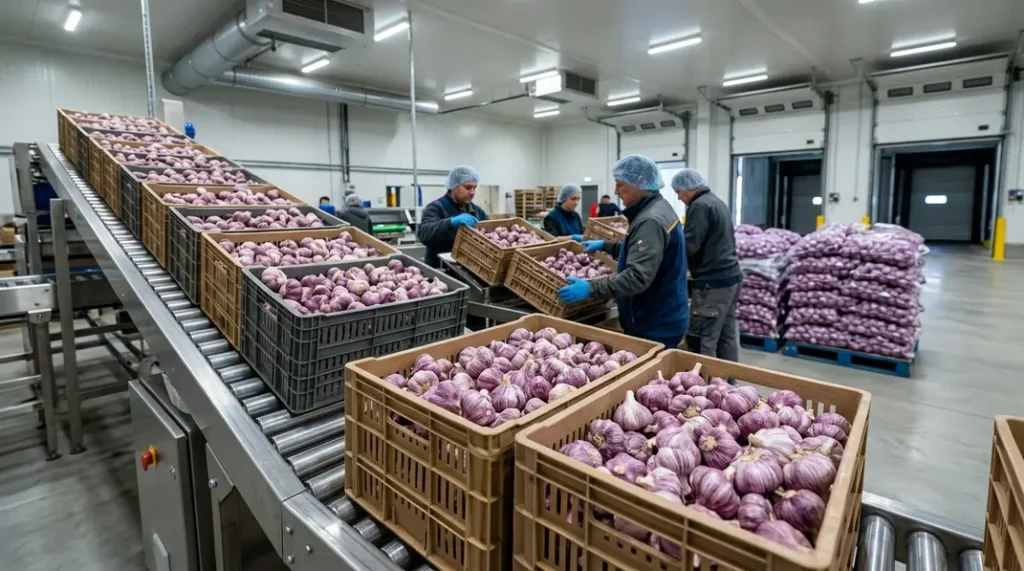
The traditional manual sorting of garlic is highly prone to human error, leading to inconsistent grading, high decay rates during transit, and costly rejections at destination ports. To eliminate these risks, advanced exporters like Happy King (Aghigh Tejarat Golshan) have revolutionized the packing house process by implementing multi-spectral AI optical sorting machines.
Our integrated AI sorting systems analyze every single bulb in real-time using high-resolution cameras and infrared sensors. This non-destructive testing method evaluates several critical quality parameters simultaneously:
By shifting from manual sorting to AI-driven quality control, we guarantee that every container of purple garlic wholesale shipped under the Happy King brand maintains a standardized, defect-free quality profile from the packaging plant to the final warehouse.
—Suggested Reading:
Garlic is a living organism that continues to transpire and metabolize after harvest. Managing the physiology of the bulb through precise temperature, humidity, and atmospheric control is vital to preventing premature sprouting, dehydration, and fungal development during extended maritime or overland transit.
Before any shipment is packed, the garlic must undergo a thorough curing process. This involves drying the outer skins, neck, and roots of the bulb. Proper curing seals the cloves, reduces moisture content, and creates a natural barrier against pathogens. Cured garlic should have a moisture content of approximately 60% to 65% in the outer wrappers, while the cloves themselves remain plump and hydrated.
Once cured and packed, the cold chain must be strictly maintained without interruption. Any fluctuation in temperature can break the garlic’s dormancy, initiating the sprouting process and ruining the commercial value of the cargo.
| Logistical Parameter | Target Set-Point | Critical Tolerance Range | Operational Impact of Deviations |
|---|---|---|---|
| Transit Temperature | -1.5°C to -3.0°C | +/- 0.5°C | Temperatures above 0°C trigger sprouting; below -4°C cause freezing injury. |
| Relative Humidity (RH) | 65% to 70% | 60% – 75% | RH > 75% promotes mold growth (Penicillium); RH < 60% causes weight loss. | 15 cbm/h (Closed during pull-down) | 10 – 20 cbm/h | Prevents CO2 accumulation; excessive ventilation increases dehydration risk. |
| Ethylene Management | < 0.1 ppm | Trace levels only | Keep isolated from high ethylene producers (e.g., apples, tomatoes). |
Packaging serves a dual purpose: it protects the physical integrity of the bulbs from mechanical impact and facilitates optimal airflow within the refrigerated container (reefer). Poorly designed packaging restricts air circulation, leading to localized hot spots and condensation, which accelerate decay.
Depending on the destination market and end-use application, we offer three primary commercial packaging solutions:
To maximize container capacity while ensuring optimal air distribution (which relies on the bottom-air delivery system of reefer containers), precise loading patterns must be followed. Pallets must be wrapped using breathable netting rather than standard stretch film to prevent moisture entrapment.
| Packaging Type | Net Weight per Unit | Units per Pallet | Total Pallets per 40ft Reefer | Total Net Weight per 40ft Reefer |
|---|---|---|---|---|
| Laminated Carton | 10 kg | 100 Cartons | 24 Standard Pallets (Industrial) | 24.00 Metric Tons |
| Rigid Plastic Crate | 15 kg | 64 Crates | 24 Standard Pallets | 23.04 Metric Tons |
| Mesh Bag (on Pallets) | 20 kg | 50 Bags | 24 Standard Pallets | 24.00 Metric Tons |
| Mesh Bag (Loose Load) | 20 kg | N/A (Floor Loaded) | N/A | 26.00 – 28.00 Metric Tons |
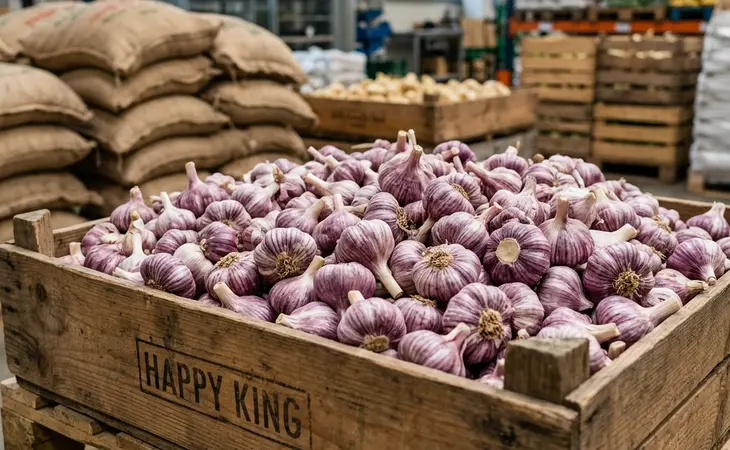
Selecting the right geographical origin is a critical decision for procurement managers. The agricultural regions of Iran, characterized by mineral-rich soils, optimal sun exposure, and stark diurnal temperature variations, produce some of the highest-quality purple garlic globally. The geographical proximity of Iran to major import markets in the CIS region, the Russian Federation, the Middle East, and South Asia makes it a highly strategic sourcing hub.
For importers in the Russian Federation and the wider Eurasian Economic Union (EAEU), securing high-potency garlic that can withstand long winter storage is a primary objective. Sourcing from specialized regional exporters who understand the logistics of the Astrakhan shipping corridor is essential. Importers looking to optimize their supply chain should consult our comprehensive guide on Sourcing Iranian Garlic Bulk: CIF Astrakhan Wholesaler Guide. This resource details the precise customs protocols, maritime routes across the Caspian Sea, and phytosanitary clearance steps required at Russian ports of entry.
Many global distributors optimize their logistical spend by consolidating their garlic shipments with other highly valued greenhouse crops. For instance, combining high-demand root crops with premium greenhouse vegetables maximizes container utilization and diversifies retail offerings. To understand how to source complementary EAEU-compliant greenhouse products, refer to our detailed analysis of the Premium Iranian Bell Pepper Exporter: EAEU Compliant Greenhouse Supply Guide. Aligning your garlic imports with structured greenhouse programs ensures consistent cold-chain management and simplified custom clearance procedures at northern border crossings.
For buyers operating in India and Southeast Asia, the transit time from Iranian ports (such as Bandar Abbas) to Nhava Sheva or Mundra is exceptionally short (typically between 5 to 8 days). This rapid transit minimized the risk of shelf-life degradation. Iranian garlic is highly sought after in India during the domestic off-season due to its large caliber and intense flavor profile, which aligns perfectly with local processing and culinary requirements.
—The import of agricultural commodities is subject to strict governmental regulations. Failure to provide correct documentation can lead to customs delays, demurrage charges, or the outright rejection and destruction of the cargo.
Every commercial consignment of purple garlic wholesale must be accompanied by a comprehensive set of legal and sanitary documents:
To ensure a seamless clearance process, importers must work with customs brokers who possess specialized experience in perishable goods. At Happy King, we proactively coordinate with our clients’ customs representatives, sending advance digital copies of all certificates for pre-clearance verification before the vessel departs the port of origin.
—The global agricultural trade is subject to seasonal fluctuations, energy cost volatility, and shipping lane dynamics. Because of these fluid market variables, relying on fixed, static pricing structures is impractical and highly risky for both the buyer and the supplier.
At Happy King, we advocate for a transparent, market-responsive dynamic pricing model. Instead of relying on rigid annual price lists that fail to reflect real-world shipping rates or agricultural yields, we utilize a real-time Request for Quote (RFQ) system. This approach allows us to calculate the absolute sharpest, most accurate pricing based on the immediate cost of raw materials, packaging components, and freight index rates.
To secure the best CIF Astrakhan / Nhava Sheva / Moscow price per ton, request a live quote. Our commercial team evaluates your specific volume requirements, packaging choices, and delivery terms to provide an optimized, fully transparent financial proposal within 24 hours.
—Success in the international purple garlic wholesale trade requires more than just high-quality soil; it demands an unwavering commitment to technological innovation, process standardization, and client-centric logistics. At Happy King (Aghigh Tejarat Golshan), we have established ourselves as a premier global agricultural enterprise by bridging the gap between field-level agriculture and elite corporate supply chain standards.
For global procurement managers, industrial food manufacturers, and tier-one retail distributors, securing a resilient, risk-managed purple garlic wholesale supply chain is a foundational prerequisite for operational profitability. Partnering with Happy King ensures that your inventory requirements are met with absolute precision, unparalleled quality, and complete regulatory compliance.
To initiate your next purple garlic wholesale procurement cycle, discuss volume availability, or receive an integrated logistical plan tailored to your destination port, contact our corporate trading desk today. Our multilingual trade experts are prepared to assist you in executing a seamless, high-performance import program.
We export purple garlic in three primary formats using 40ft reefer containers: 10 kg laminated open-top cartons (24.00 MT net per container), 15 kg rigid plastic crates (23.04 MT net), and 20 kg monofilament mesh bags (24.00 MT on pallets or up to 28.00 MT loose loaded). All palletized shipments are wrapped with breathable netting to ensure optimal air circulation during transit.
We mitigate sprouting and decay through a strict post-harvest protocol. First, the garlic is thoroughly cured to dry the outer skins. Second, we utilize advanced AI optical sorting machines equipped with infrared sensors to detect and remove bulbs with internal sprouting invisible to the human eye. Finally, we maintain a continuous cold chain at -1.5°C to -3.0°C with 65% to 70% relative humidity.
We grade our purple garlic into Super Premium (65mm+), Class I (55-64mm), and Class II (45-54mm) calibers. Each shipment is compliant with EU, EAEU, and Indian market regulations, and is accompanied by a Phytosanitary Certificate, Certificate of Origin, and independent laboratory analysis reports confirming that heavy metals (Lead < 0.1 mg/kg) and pesticide residues are within legal MRL limits.
Because agricultural market conditions, energy costs, and shipping rates fluctuate, Happy King uses a dynamic pricing model instead of fixed price lists. Buyers can submit a Request for Quote (RFQ) specifying their volume, caliber, and packaging requirements. Our sales desk will provide a real-time, optimized quote under key incoterms, including FOB, CIF Astrakhan, and CIF Nhava Sheva.
Global food supply chains demand absolute phytosanitary compliance and shipping reliability. Lock in your seasonal allocation of premium purple garlic by requesting a dynamic proforma invoice (RFQ) today. Check detailed grade standards, customizable packaging options, and secure competitive direct-from-origin FOB/CIF pricing for your target port.